
The Project Advisory Meeting of the African Health Initiative Community of Practice (AHI CoP) ended with participants pledging to scale up some of the innovations they had seen. “The Community-based Health Planning and Services (CHPS) initiative represents the period when at the [health] cross-roads Ghana took the right turning”, stated Prof. Ayaga Bawah, Principal Investigator of the AHI CoP project being implemented by country teams in Ghana, Ethiopia, and Mozambique. He said that the impact of CHPS has been huge and impressive over its 25 years of implementation. “CHPS has lowered fertility, improved maternal health and given every child born in Ghana a clear chance to live to celebrate their 5th birthday, and thrive”, stated Prof Bawah, who is also the Director of the Regional Institute for Population Studies (RIPS) at the University of Ghana, Legon, which hosts the AHI CoP Project Secretariat. He noted that the challenges encountered in the implementation of CHPS are challenges associated with the scaling of any innovation, and these provide a learning opportunity for both policymakers and researchers. Dr. Boakye-Boating, director of Programme Planning, Monitoring, and Evaluation (PPME) of the Ghana Health Service (GHS), who represented the Director General of the GHS, said that thanks to CHPS, Ghana is on course to achieve universal health coverage by 2030. “I will be borrowing more than a leaf from Ghana’s celebrated CHPS initiative to inform the Community Sub-Structure Health programme that we are in the process of developing in Mozambique”, pledgedDr. Quinhas Fernandes, the Public Health National Director at the Ministry of Health in Mozambique, who plays the dual role of researcher and policy maker.
Funded by the Doris Duke Foundation (DDF), the AHI CoP aims to support a vibrant community of implementation researchers, policymakers, and practitioners by building the capacity of early- and mid-career implementation researchers and disseminating key learnings and publications developed by the community. It was launched in 2007 to shift the focus from single-disease programs to strengthening health systems to deliver integrated primary health care in underserved regions of Africa. The second annual Project Advisory Meeting was held to review the progress of the workplan towards project goals, find opportunities for inter-country collaboration, and plan activities for the next 12 months. The meeting was held in two phases: indoor conference presentations and plenary discussions, and field visits.
During the first phase, attendees from the three participating countries made country-specific presentations of project activities, followed by plenary discussions before project advisors infused the discussions with their insights, identified gaps and areas for improvement, and made specific recommendations for consideration. One of the advisors, Prof. Lisa Hirschhorn, noted that the funding from the DDF has enabled the emergence of radical innovations that must be sustained. “It is now up to policy makers, health service providers and researchers to put their heads together to find the needed resources to not only sustain the gains made but scale them to other settings of the continent.” She also believed that building individual capacity was good, but building institutional capacity was more sustainable if we aimed to build resilient health systems. Whereas Prof Kenny Sherr of the University of Washington was concerned that there is tremendous demand for implementation science but little supply of it, Prof Patrick Kachur from Columbia University advised that “optimizing learning through embedded implementation is a key strategy for sustaining the gains under AHI CoP.” Dr. Koku Awoonor-Willliams, who is a Technical Advisor to the Ghana Minister for Health, said that no matter how compelling a piece of evidence is, if it cannot be reduced to comprehensible formats for policymakers to imbibe, it is not useful evidence. “Evidence must be simple to read and easy to understand”, said Dr. Awoonor-Williams, popularly known as Koku, who has played pivotal roles in CHPS at different levels since its inception in 2000. “But, above all, evidence must be presented in a manner that arouses the policy maker’s interest.” He charged the project to look beyond the current timelines. He was upbeat that “December 2026 must not be the end; it must be the end of a new beginning.” Overall, the Project Advisors were concerned about the future. “How are you learning for future work, and how are you learning from the communities?” asked Prof. Hirschhorn rhetorically. The Advisors also agreed that the AHI CoP should focus on impact - what difference it is making in the lives of people and improvements to systems - beyond the number of people trained. Ms. Sarah Gold, a Research Assistant at Columbia University, presented using VosView to demonstrate how to map connections between researchers and their published works on PubMed. Sarah’s presentation helps address a major concern about having Web presence for researchers and showcasing research evidence. The question of “what do we do with success?” brought knowledge translation to the centre of discussion. Mrs. Sophia Ampofo-Kusi, Chief Health Planner at the PPME, recommended the use of multiple platforms, including YouTube, to amplify the evidence generated. Dr. Awoonor-Williams concurred by suggesting the use of what he called “foot soldiers” or community members to spread the gains being made in health service delivery. The first phase of the meeting concluded with Mozambique agreeing to host the third Project Advisory Meeting by the end of October 2026.
The second phase was a field visit to the North Tongu District in the Volta Region in southeastern Ghana. The purpose was to share findings of the A Programme for Strengthening Community-Based Health and Planning Services (CHPS+), which was launched in 2016 to scale up the lessons learned from the Ghana Essential Health Interventions Programme (GEHIP). CHPS+ was a partnership between the GHS, RIPS at the University of Ghana, University of Health and Allied Sciences, University for Development Studies, and Mailman School of Public Health at Columbia University. The programme was implemented in rural districts through learning exchanges and catalytic resources, in which trainee districts developed solutions to address context-specific challenges to CHPS implementation. The presentation by the CHPS+ Project Director for Research, Dr. Pearl Kyei, a Senior Lecturer at the University of Ghana, showed that CHPS+ greatly improved safe motherhood and built district capacity to leverage resources for service expansion.
The Volta Regional Director of Health Services, Dr. Atsu Dodor, who chaired the dissemination meeting, said that CHPS works and there is no controversy about it. However, he expressed concern over grey areas which require the need to redefine CHPS within contemporary realities. He wanted to know “of the 16 implementation milestones that guide CHPS roll out, what milestones are indispensable to successful CHPS implementation that the health system can handle?” Dr. Atsu also noted that home visits by the Community Health Officer are a core function under CHPS “but what exactly do home visits contribute to improved health of the community?” He pledged his readiness to use the evidence that the AHI CoP is generating but was quick to add that “the evidence has to be something I can touch and feel.” The Regional Director recommended that Community Health Officer training be incorporated into the curriculum of nurse training institutions so that nurses can be posted to CHPS zones upon graduating without needing additional training, as is presently the case.
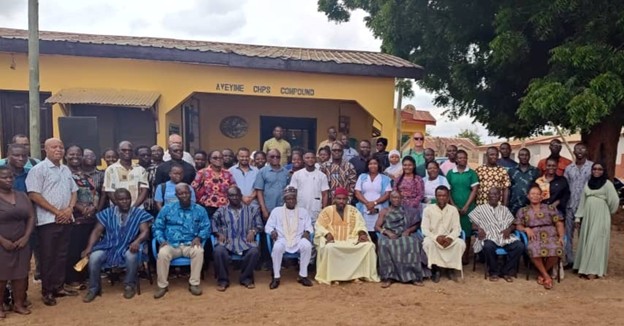
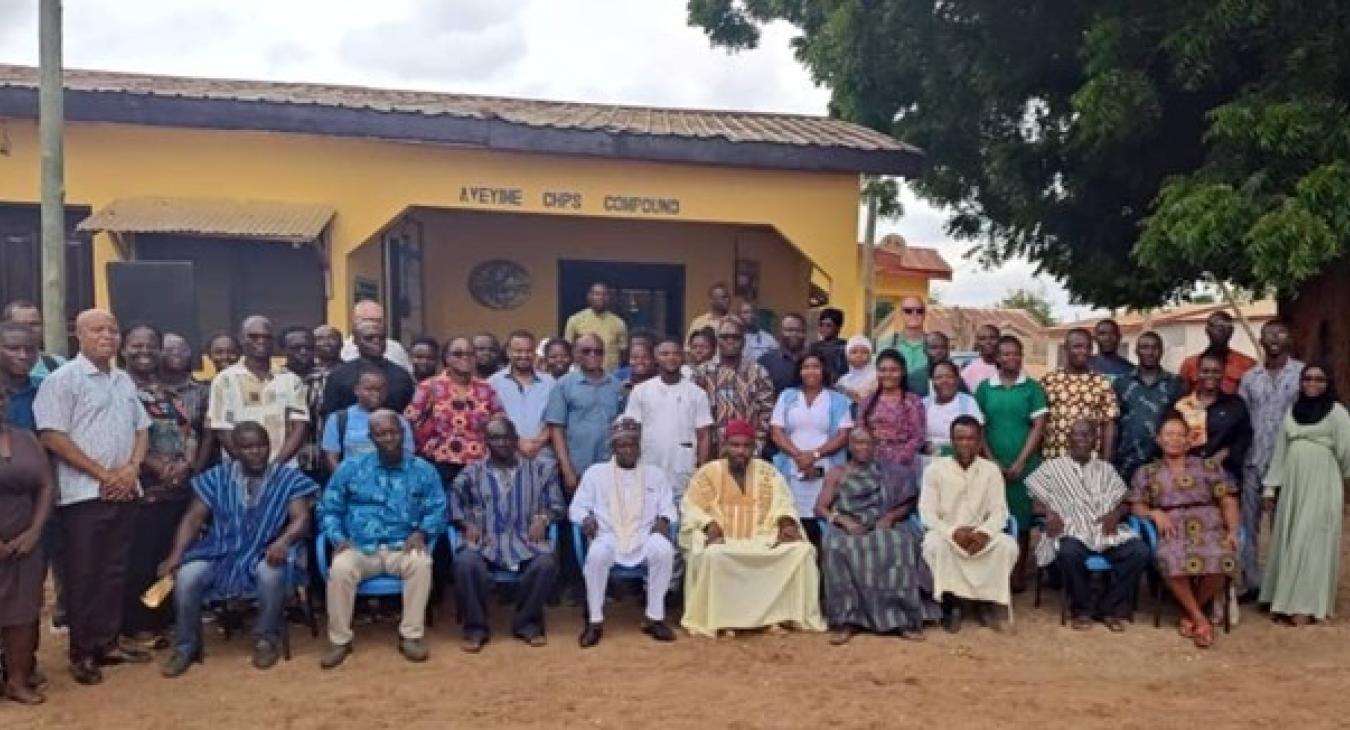
An opportunity to see firsthand the implementation of CHPS on the ground took the teams to the Aveyime CHPS Compound in the North Tongu District for a field visit. Situated within a Muslim community, the CHPS Compound serves a population of over 5,300 people distributed across 12 essentially farming communities. The team first interacted with community leaders and other members at a mini durbar before visiting the facility. With five full-time professional staff, including a midwife and health volunteers, the Aveyime CHPS Compound represents a model CHPS compound with the full complement of health services envisaged under the CHPS initiative. The community unanimously called for the upgrading of the CHPS Compound into a Health Centre to respond to the growing health needs of the community. The team interacted with the staff of the facility, reviewed service plans and delivery charts posted on the walls, and sought clarification on how immunisations, child welfare clinics, family planning, treatment of minor ailments, deliveries, home visits, and health education were conducted. Mrs. Beatrice Enyonam Ananga, the in-charge at the CHPS Compound, reiterated the community’s call for a Health Center, highlighting that although the facility can test for malaria and blood sugar levels, it cannot confirm certain cases before treatment without lab services which can only be provided to health centres. She added that although the CHPS Compound monitors the blood pressure of clients, they cannot diagnose and treat people with blood pressure issues.
Mr. Ewe Raphael, the first Community Health Officer to be posted to the Aveyime Central CHPS Zone was elated about how far CHPS services have improved over a period of 10 years. “When I was posted here in June 2016, there was just empty space, a few chairs, and I provided services from my single room residence”, he reminisced with pride in his voice. “But I was confident things would improve this much, given the level of community support, development partner interest, and the quality and commitment of the health leadership.” The Aveyime CHPS Compound which comprises a service delivery area and separate living quarters for the health staff, was constructed by the community.
“The level of community support for the Aveyime CHPS Compound, and engagement between the community and the health service, is impressive and inspiring”, observed Dr. Amare Tariku, an Associate Professor at the University of Gondar in Ethiopia. Dr. Fernandes, a Mozambican health practitioner was critical of the CHPS programme, noting that, “with five professional staff, the Aveyime CHPS facility should be providing a wider range of health services than they are currently doing.” He empathized that, compared to Mozambique, Aveyime is not a rural area, and “their call for upgrading the facility to provide more services is justified.” He disclosed that Mozambique was beginning to experiment with training ordinary community members for six months as community health workers to deliver a package of health services, and that the experience gained in Ghana was useful and timely.
In his briefing before the field visit, the North Tongu District Director of Health Services, Mr. Michael Kofi Zigah, highlighted the achievements of the district, which has catalytic resources and engaged in peer learning exchanges under the CHPS+ programme. This empowered them to advocate for resources from a diverse range of stakeholders. He was concerned that despite the achievements, some communities are cut off when the rain sets in and can only be reached using Zipline, the GHS drone service. This, he said, complicates picking community-level neonatal mortality data which was a great concern to Dr. Quinhas of Mozambique.
The chief of Aveyime, Togbe Gboku Wo III, disclosed that land had been earmarked for the construction of a Polyclinic for Aveyime. His remarks resonated with the Chief Imam, Mallam Mohammed Sani Shaibu, who pledged the support of the Muslim “umma” (community) for future projects. The Chair of the Community Health Management Committee, Ms. Gati Holali Comfort, said that the committee is propelled by self-motivation but they would welcome any form of support to keep their spirit of voluntarism high.
- Log in to post comments